



Pushkar Travel Guide 2026: Brahma Temple, Camel Fair & the 52 Ghats
The short answer: one night and two half-days is right for Pushkar. Arrive in the afternoon, walk the bazaar, take the ropeway up to Savitri Temple for sunset, and be at the ghats by six the next morning — that hour is the whole reason to stay. October to March is the comfortable season; February and March are the sweet spot. Budget roughly ₹1,500–₹3,000 a day per person, which makes Pushkar the cheapest town on a Rajasthan circuit for fifty-one weeks of the year. The one week it is not is Camel Fair week in late October or November, when rates multiply and rooms need booking six to nine months ahead. The single decision that shapes the trip is whether you want the fair or the quiet town, because they are not the same place
Pushkar runs on a different clock to the rest of Rajasthan.
You come over the Nag Pahar ridge from Ajmer, drop into a bowl of hills, and find a town of about twenty thousand people wrapped around a small green lake. There are more than four hundred temples here and fifty-two ghats. There is also no meat, no eggs and no alcohol sold anywhere within the town — a rule that predates tourism by centuries and is still observed.
That combination produces something unusual. On any given evening at Varaha Ghat you will find pilgrims performing rituals their families have performed for generations, backpackers on their third month in India, a couple learning tabla, and a group of Rajasthani women selling marigolds — all in the same fifty square metres, and none of them finding it strange.
The origin story explains the town's whole reason for existing. Brahma, the creator, is said to have dropped a lotus flower here, and water sprang up where the petals fell. He then performed a yagna at the lake — and Pushkar has one of the very few significant Brahma temples anywhere in India, in a country with tens of thousands of temples to Shiva and Vishnu. That rarity is the town's identity and the reason pilgrims have been walking here for centuries.
Most travellers give Pushkar half a day between Jaipur and Udaipur. That is a mistake, and this guide explains why. Our Rajasthan tour packages build in an overnight, because Pushkar's best hours are the ones the day-trippers miss.
How many days do you need in Pushkar?
One night and two half-days. That is the standard and it is standard because it works: an afternoon for the bazaar and a Savitri sunset, a morning for the ghats and the Brahma Temple before the crowds. Anything less and you are choosing between the town and the light, which are the two halves of the same trip.
• Half a day only: Brahma Temple, a walk along the ghats, the bazaar, Savitri at sunset. You will see Pushkar and miss the sunrise, which is the part people actually remember.
• One night, two half-days: the right answer for almost everyone.
• Two nights: adds Ajmer and the Dargah Sharif properly, rather than squeezing it into a departure morning.
• Three or more: only for the Camel Fair, for Holi, or for people who came for the rooftop-café version of Pushkar and are in no hurry. Both are legitimate reasons.
Why Pushkar needs an overnight, not a stopover
The day-trip version of Pushkar is: arrive at noon, walk the bazaar, see the Brahma Temple, leave by four. Under that schedule the town is hot, crowded and a bit touristy, and people come away underwhelmed. They are not wrong about what they saw. They saw the worst four hours of the day.
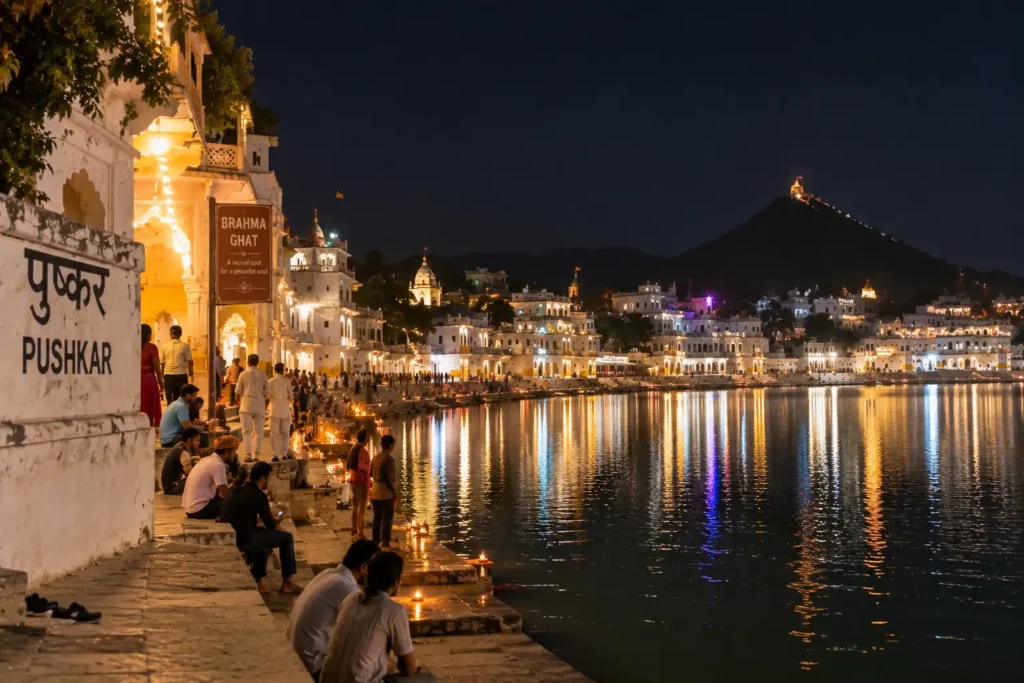
The overnight version is a different town. Sunrise at the ghats is the best hour in Pushkar — mist on the water, bells, almost nobody there. Sunset from Savitri Temple on the hilltop gives you the whole lake, the town and the desert beyond in one frame. Both of these are outside day-trip hours, and neither can be bought back later.
Pushkar is also small enough that a single night changes your relationship with it. You start recognising shopkeepers. You find the rooftop with the good coffee. It stops being a stop and starts being a place.
Pushkar is also small enough that a single night changes your relationship with it. You start recognising shopkeepers. You find the rooftop with the good coffee. It stops being a stop and starts being a place.
The honest counter-argument: if you are running a compressed Golden Triangle plus Udaipur itinerary and Pushkar is genuinely a detour, a well-timed afternoon visit with a Savitri sunset is still worthwhile. Just do not schedule it as a lunch break. Our 7-day Rajasthan itinerary puts Pushkar on the Jaipur–Udaipur leg as a sacred stopover, which is the compressed version done properly.
Pushkar Camel Fair — what it actually is
The Pushkar Fair is the town's global calling card, and it is the one thing on this page with a deadline attached. Read this section before you fix any dates.
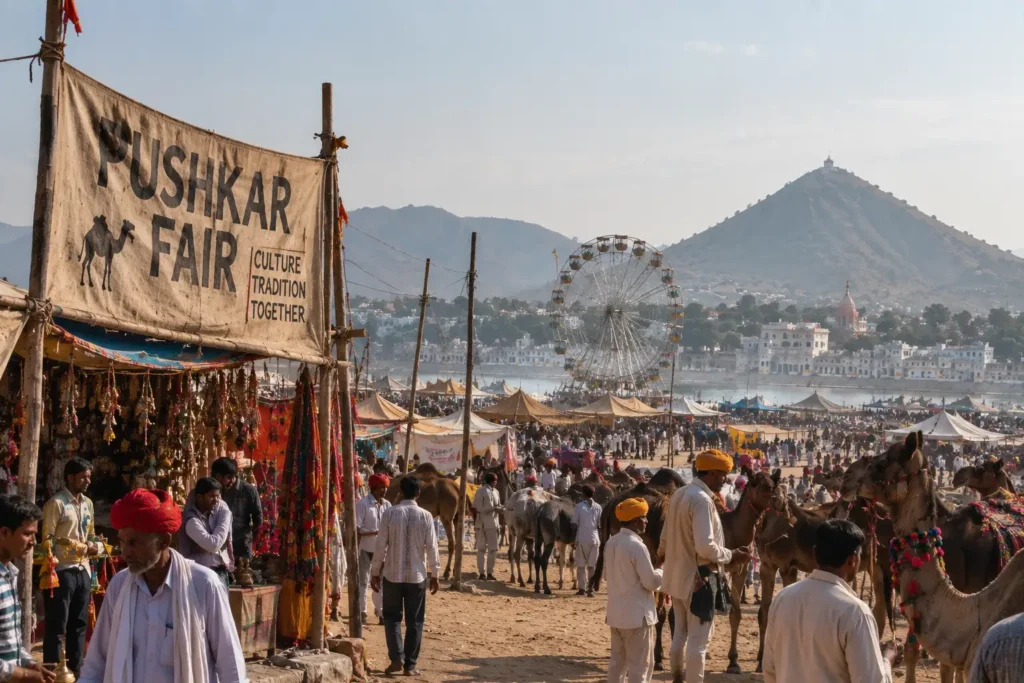
The working livestock market underneath the festival
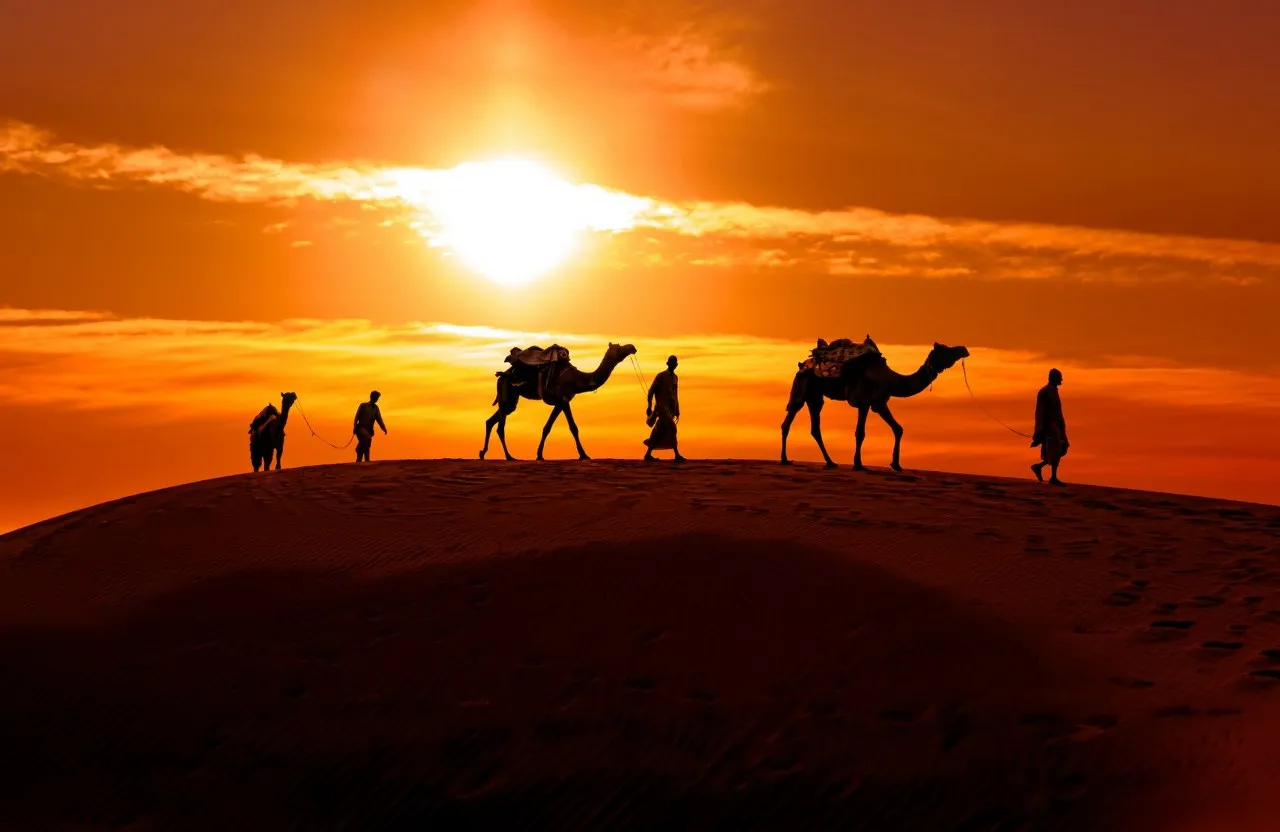
At its core this is a working livestock market that has run for centuries. Thousands of camels, horses and cattle are brought in by traders from across Rajasthan and beyond, and serious money changes hands. Around that, a fairground has grown up: folk performances, moustache and turban competitions, camel decoration contests, a Ferris wheel, food stalls, and in recent years a hot-air balloon operation. The final days coincide with Kartik Purnima, when pilgrims bathe in the lake in very large numbers.
Those two things — the trade fair and the religious bathing — are the fair. The tourist programme is built on top of them, and it is the part most likely to disappoint someone expecting an authentic scene. Arrive for the trading and you get the real one.
When it happens, and why you cannot trust a remembered date
The fair falls in the Hindu month of Kartik and ends on Kartik Purnima, which places it in late October or November depending on the year. Because it follows the lunar calendar, the Gregorian dates move by weeks between years. Do not plan flights around a remembered date or a date you found on a blog. Confirm the current year's schedule on Rajasthan Tourism's own Pushkar page before booking anything at all.
Should you go?
Go if: you want spectacle, photography, and one of the great gatherings in India. It is genuinely unlike anything else, and people who want it are rarely disappointed by it.
Do not go if: you want the peaceful lakeside Pushkar described in the rest of this guide. During fair week the town's population multiplies, hotel rates rise several times over, the lanes become impassable, and the quiet ghats are anything but. Every complaint we hear about the fair comes from someone who booked it expecting the other town.
The nearby alternative nobody mentions: the Nagaur Cattle Fair in January or February is the second-largest livestock fair in the state and draws a fraction of the tourists. If it is the trading floor and the animals you want rather than the fairground, Nagaur is the better trip and the accommodation is not a crisis.
If you do go — the six-to-nine-month rule
Book accommodation six to nine months ahead. That is not a marketing line; it is the point at which the affordable rooms are gone and the remaining ones are priced accordingly. Tented camps set up on the fairground are a legitimate option and are often better positioned than town hotels, but they sell on the same timeline.
Arrive a day or two before the peak. The livestock trading in the early days is the most authentic part of the whole thing and the crowds are thinner. The last two days are when the pilgrim numbers spike for Kartik Purnima and the town stops functioning as a place you can walk around.
The folk performances are not filler. Manganiar and Langa musicians are a serious tradition and the fair is one of the few places you can hear a lot of them in one week. Our guide to Rajasthan's traditions and festivals explains what you are listening to.
International visitors should also get the paperwork moving early — fair week is the one time of year when a late visa turns into a cancelled trip rather than a delayed one. Our India visa and travel guide covers what to start and when.
Best places to visit in Pushkar
Everything below except Ajmer is inside a twenty-minute walk of the lake. Pushkar is a small town and its sights are stacked on top of each other, which is why one night is enough.
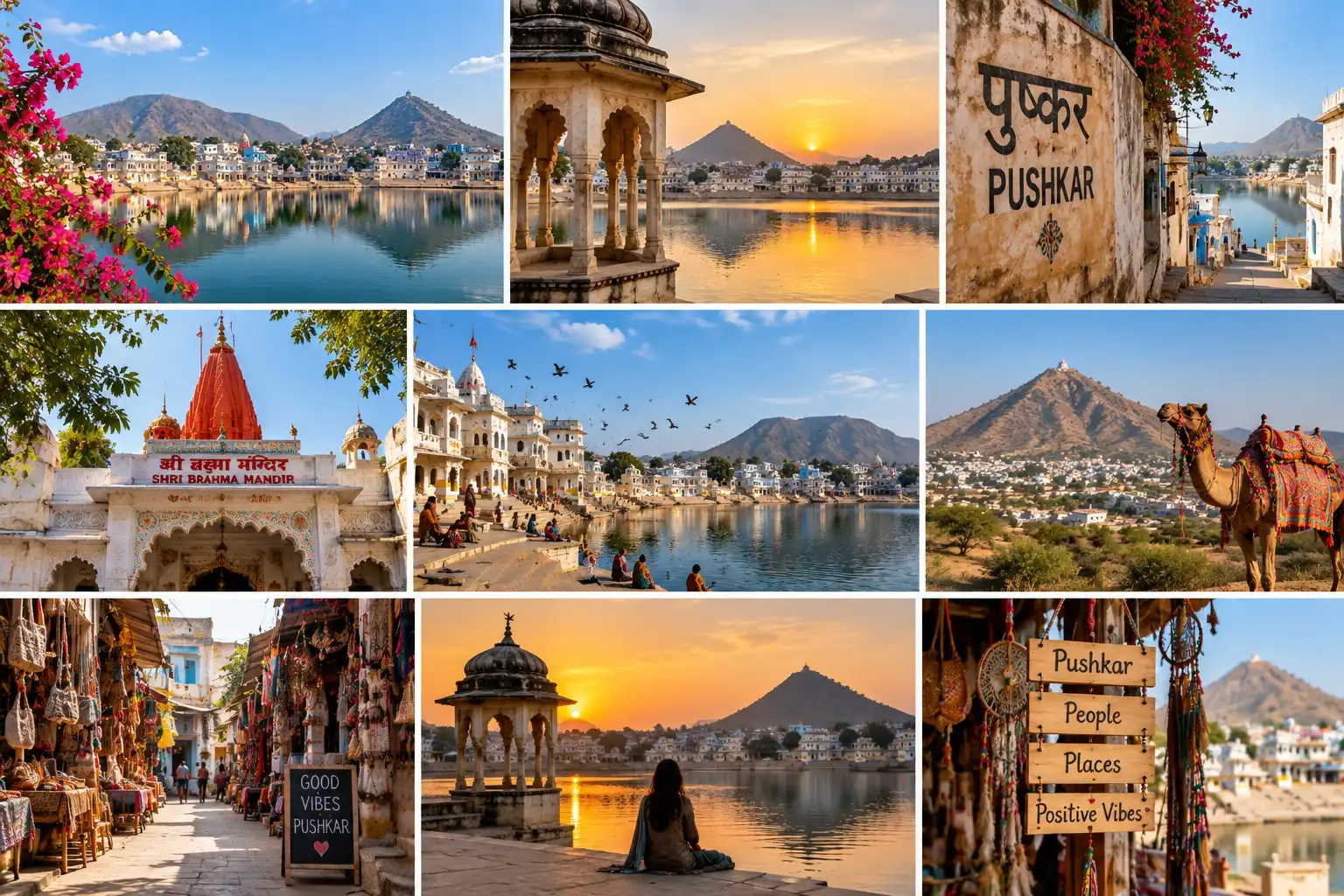
Jagatpita Brahma Temple
The reason Pushkar exists on the pilgrimage map. The present structure dates largely to the fourteenth century with older foundations, marked by a distinctive red spire and a hamsa — goose — motif. Inside, the four-faced image of Brahma sits in a marble sanctum, with Gayatri to one side and Savitri's shrine on the hill above.
Practical reality: shoes off outside, and photography is restricted inside the sanctum — phones and cameras usually have to be deposited at the counter. There is no entry fee, though there are donation points, and you are not obliged to give at every one. Most importantly, the temple closes in the middle of the day. Go early morning or late afternoon, and do not build a lunchtime arrival around it.
Pushkar Lake and the 52 ghats
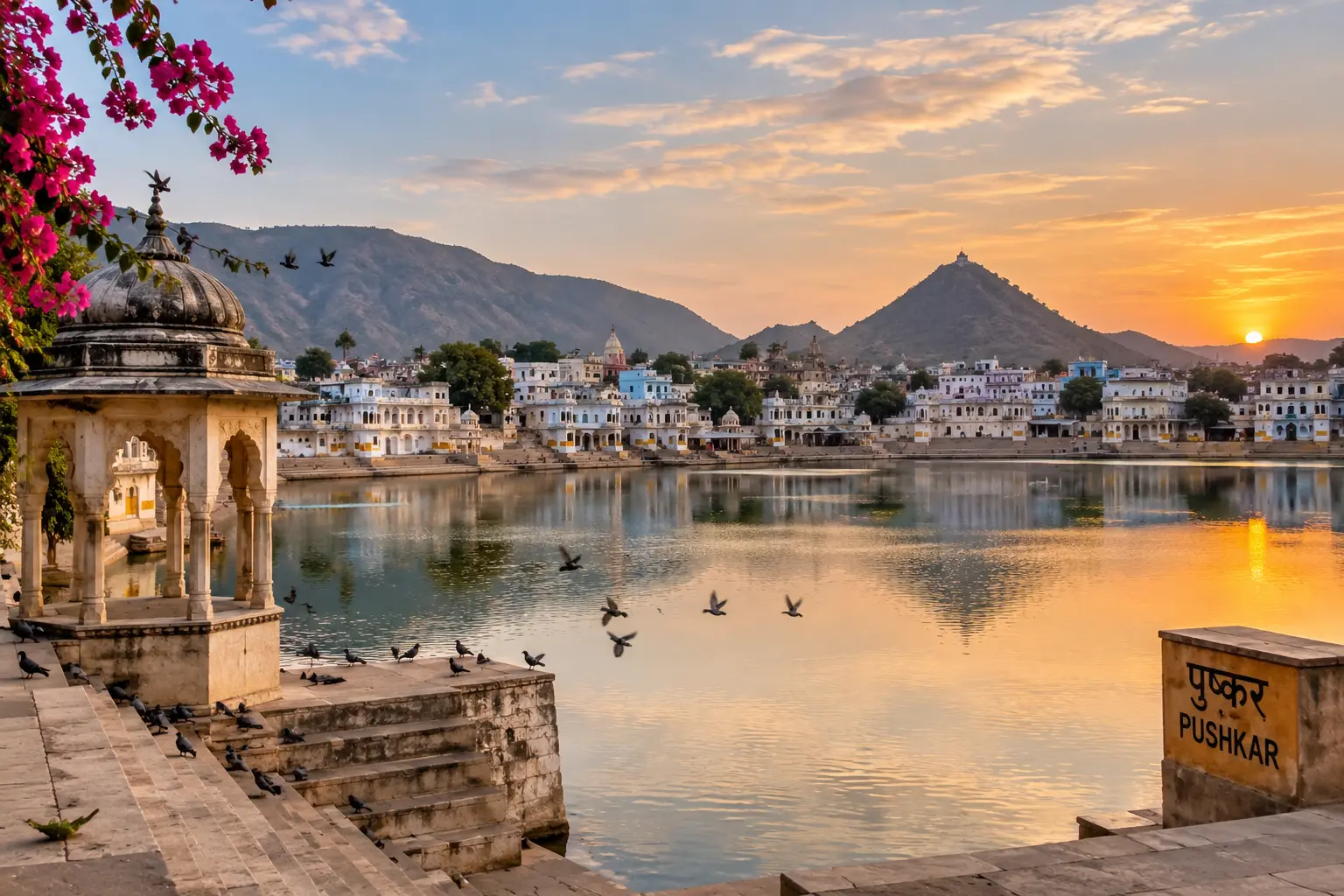
The lake is the town's centre in every sense — physically, spiritually and socially. Fifty-two ghats descend into it, each historically associated with a different ruler or community, and pilgrims come to bathe here particularly around Kartik Purnima.
Where to sit: Varaha Ghat and Gau Ghat are the main ceremonial ones. Brahma Ghat is quieter. The sunset light off the water with the white temple spires behind it is genuinely lovely, and the sunrise is better still.
Rules to respect: remove shoes before stepping onto the ghats. No photography of people bathing. The lake is a sacred site, not a viewpoint, and the town takes that seriously — visitors who behave accordingly are treated warmly, and the ones who do not are told so.
A note on water levels: Pushkar Lake depends on monsoon rainfall and has been drained for desilting more than once in recent decades. In a weak monsoon year, levels drop noticeably by late spring. If the lake view is central to your plans, it is worth checking recent photographs rather than the ones on booking sites.
Savitri Temple
On the hill above the town, dedicated to Brahma's first consort. The climb is roughly 200 metres of vertical on steps — about 45 minutes at a moderate pace — or a few minutes by ropeway, which most visitors now take.
Go for sunset. The view covers the entire lake, the temple town, the surrounding Aravalli hills and the desert opening out beyond. It is the single best viewpoint in Pushkar and, on its own, the reason to stay the night. The ropeway has fixed operating hours, so check the last descent before you go up — walking down in the dark is possible but it is not what you planned.
Ratnagiri Hill and Gayatri Temple
The opposite hill, dedicated to Gayatri, and the place to be at sunrise rather than sunset. It is a steeper walk with no ropeway, considerably quieter, and the morning light over the lake is better than the evening light. Serious photographers choose this one. If you are only doing one hill and you are staying overnight anyway, this is the more rewarding of the two.
Varaha Temple and Rangji Temple
Varaha Temple honours Vishnu's boar avatar and is one of the town's oldest and most significant. Rangji Temple, in contrast, is a striking South Indian-style structure with a tall gopuram that looks entirely unexpected in a Rajasthani desert town — a reminder of how far the pilgrimage networks reached and how much money moved along them. Both are short stops and both are worth the ten minutes.
The bazaar
Pushkar's main market street runs the length of the town and is one of the best small-scale shopping experiences in Rajasthan: silver jewellery, embroidered and mirror-work textiles, leather-bound journals, brass, and a very large amount of hippie-trail clothing. Prices are negotiable and the bargaining is friendly rather than aggressive, which is not true everywhere in the state.
Buy: silver by weight — ask for the day's rate before anything is weighed — block-printed cotton, and Rajasthani puppets. Be careful with: anything sold as antique, and gemstones sold as an investment. Neither claim can be checked in the twenty minutes you have.
Ajmer and the Dargah Sharif (half day)
Fifteen kilometres over the hill sits Ajmer, and the Dargah Sharif — the shrine of the twelfth-century Sufi saint Khwaja Moinuddin Chishti and one of the most important pilgrimage sites in South Asia, visited by people of every faith. The atmosphere during qawwali in the evening is extraordinary. The Ministry of Tourism's Ajmer Sharif page gives the history straight, which is useful because a lot of what is online about the shrine is written by people selling services at it.
Dress modestly, cover your head, and expect crowds. It pairs naturally with Pushkar as a half-day and gives you two entirely different devotional traditions within one afternoon, which is a genuinely unusual thing to be able to do anywhere.
Anyone building a wider pilgrimage route should look at our spiritual tour packages across India — Pushkar and Ajmer are the natural Rajasthan entry point to that circuit.
The donation pressure nobody warns you about
This is the single most useful thing on this page for a first-time visitor, and it is why it has its own heading rather than sitting in a footnote.
Priests and self-appointed "guides" at the temple and around the ghats sometimes press visitors into a "Pushkar Passport" ritual — a thread tied on the wrist, a short puja at the water — and then demand a large donation, occasionally naming a specific high figure and applying real social pressure in front of an audience. It is uncomfortable by design.
The ritual itself is genuine and meaningful for the people who want it. The coercion is not. If you want to participate, that is a real thing to do and you should — just agree the amount before anything begins, in numbers, out loud. If you do not want to, decline before the thread goes on your wrist rather than after, and keep walking. Firm and courteous works, and it is understood.
The ritual itself is genuine and meaningful for the people who want it. The coercion is not. If you want to participate, that is a real thing to do and you should — just agree the amount before anything begins, in numbers, out loud. If you do not want to, decline before the thread goes on your wrist rather than after, and keep walking. Firm and courteous works, and it is understood.
Perfect 2-day Pushkar itinerary
Day 1 — arrival, bazaar and Savitri sunset
• Afternoon: arrive from Jaipur, roughly three hours. Check in, rest through the heat.
• 4:00 PM: walk the bazaar end to end. Shop, or just look.
• 5:00 PM: ropeway or climb up to Savitri Temple for sunset.
• 7:00 PM: evening aarti at the ghats. Sit and watch rather than photograph.
• 8:30 PM: dinner on a lakeside rooftop. Strictly vegetarian and no alcohol, town-wide — plan for it rather than discover it.
Day 2 — sunrise, temples and Ajmer
• 6:00 AM: sunrise at the ghats, or climb Ratnagiri for the Gayatri Temple view. This is the best hour of the trip.
• 8:00 AM: Brahma Temple, before the crowds and before the midday closure.
• 9:30 AM: breakfast, then Varaha and Rangji temples.
• 11:30 AM: drive to Ajmer for the Dargah Sharif, half a day.
• Evening: return to Pushkar, or continue to Jodhpur or Udaipur.
If you only have half a day
Brahma Temple, a walk along the ghats, the bazaar, and Savitri Temple at sunset. Skip Ajmer entirely rather than rushing it — a hurried Dargah visit is worse than no Dargah visit. Arrive after three rather than at noon and you get the good version of the short trip.
Best time to visit Pushkar
October to March, with days between 22°C and 30°C and cool evenings. December and January nights get genuinely cold — bring a jacket.
February and March are the sweet spot for most travellers: warm days, quiet ghats, reasonable rates, and Holi in March, which Pushkar celebrates with real enthusiasm. November is fair season — extraordinary, and the opposite of relaxing. Decide which Pushkar you want before you fix dates.
April to June reaches 38–43°C and July to September brings the monsoon, which refills the lake and greens the hills at the lowest rates of the year. For the full month-by-month picture across every Rajasthan city, see our best time to visit Rajasthan guide.
How to reach Pushkar
By road is the only practical way. Pushkar has no railway station of its own and no airport.
• From Jaipur: about 145 km, roughly 3 hours on good highway. The Jaipur to Pushkar cab is the most common approach and is easily done as a morning drive.
• From Delhi: about 400 km, 6.5 to 7.5 hours. Most travellers break this at Jaipur — our Delhi to Jaipur cab guide covers that first leg.
• From Jodhpur: about 190 km, roughly 3.5 hours.
• From Udaipur: about 280 km, roughly 5 hours.
Nearest railhead: Ajmer Junction, 15 km away, well connected to Delhi, Jaipur, Ahmedabad and Mumbai. Taxis and autos run from Ajmer to Pushkar over the hill.
Nearest airport: Jaipur International (JAI), about 145 km. Kishangarh is closer at around 55 km but has very limited scheduled service and it changes year to year, so verify before planning around it.
Building it into a circuit. Pushkar slots between Jaipur and Jodhpur or Udaipur without adding a long detour, which is why it belongs on almost every Rajasthan itinerary. Continuing west, the Jaipur to Jodhpur cab route passes close by, and from there the Jodhpur to Jaisalmer cab completes the desert run.
What Pushkar actually costs in 2026
Per person, per day, excluding intercity transport. Pushkar is the cheapest destination in this guide series outside fair week, and it is not close.
• Budget (₹1,200–2,500/day): guesthouse near the ghats, café meals, walking everywhere. Pushkar's long backpacker history means the budget end here is unusually good rather than merely cheap.
• Mid-range (₹3,000–5,500/day): lakeside heritage hotel or garden property, rooftop dining, a cab for Ajmer.
• Luxury (₹10,000+/day): the handful of luxury desert resorts and heritage properties just outside town.
During the Camel Fair, multiply these by three to five. That is not an exaggeration and it is not a negotiating position — fair-week pricing is a separate market with its own rules, and it is set months before you arrive.
Jaisalmer is the cheapest of the major Rajasthan cities for accommodation and food. The desert camp is the exception and it is a separate line item that ranges from ₹1,500 to ₹30,000 per person for a single night depending on tier — a twenty-fold spread, which is unlike anything else on a Rajasthan trip.
Free or near-free: the Brahma Temple, the ghats, Ratnagiri Hill, the bazaar. Pushkar has very few paid attractions, which is part of its charm and part of why the budget tier works so well here. Where to spend: the ropeway, and a rooftop room with a real lake view rather than a lake glimpse. Where people get caught out: unagreed donation amounts at the temple and ghats, camera charges at a couple of the private temples, and fair-week rates quoted per night but charged on a minimum-stay basis.
Our complete Rajasthan travel guide sets Pushkar's costs in the context of a full state itinerary.
What to eat in Pushkar
• Malpua and rabri — the town's signature sweet, sold hot from a handful of long-established shops near the bazaar. This is the one thing to eat here that you cannot eat as well elsewhere.
• Dal baati churma — the Rajasthani classic, and Pushkar's vegetarian kitchens do it properly.
• Kadhi and gatte ki sabzi — gram-flour dumplings in yoghurt curry. What people here actually eat at home, and the strictly vegetarian rule means the local cooking is the main cuisine rather than a side option.
• Lassi and masala chai — both better in the lanes off the bazaar than on the main rooftop strip.
• The rooftop cafés — banana pancakes, long conversations and indefinite stays. This is a decades-old part of the town's character and it is genuinely pleasant. Just do not let it replace the temples and ghats you came for.
Remember the constraint: no meat, no eggs, no alcohol anywhere in town. This is a town-wide religious observance, not a hotel policy, and it includes what you bring in with you. Travellers who arrive expecting to negotiate this have a bad first evening.
Local tips most Pushkar travel guides leave out
Shoes off before the ghats, always. This is the single most common mistake visitors make and it causes genuine offence. There is nowhere to leave them and no one will mind you carrying them.
Sunrise beats sunset here. Both are good, but the ghats at six in the morning are what people remember, and almost every itinerary schedules the lake for the evening instead.
Agree ritual donations in advance. Covered above, and it is worth repeating because it is the one thing that turns a good day here into a bad memory.
Book the Brahma Temple around the closure, not around your lunch. The midday shut is the most common wasted hour in a Pushkar day trip.
Watch the monkeys on the Ratnagiri and Savitri climbs. Do not carry visible food and do not carry a loose bag on the steps.
Cash for small vendors, flower sellers and donations. UPI works in shops and hotels; the ghats and the fair stalls largely still do not.
Dress for a temple town, not a beach town. Shoulders and knees covered is the norm rather than the exception here, and it makes a visible difference to how you are treated.
Frequently asked questions
How many days do you need in Pushkar?
Why is the Brahma Temple in Pushkar so special?
When is the Pushkar Camel Fair?
Is Pushkar worth visiting outside the fair?
Can you drink alcohol or eat meat in Pushkar?
Is Pushkar safe for solo travellers?
How far is Pushkar from Jaipur?
Can Pushkar be combined with Udaipur?
Pushkar or Ajmer — if I can only do one?
Is Pushkar good for a honeymoon?
Does Pushkar fit into a wider pilgrimage route?
Plan your Pushkar trip with Root Indians
Pushkar is a small town that gives up its best hours to people who stay overnight and know where to be at six in the morning. Getting that right is mostly a matter of timing and transport, which is exactly what we handle.
Root Indians is based in Jaipur, three hours from Pushkar, with our own AC fleet and background-verified drivers who run this route constantly. We arrange the Jaipur–Pushkar–Ajmer loop as a day trip, an overnight, or as part of a longer circuit — and we book fair-week accommodation early, because by September there is nothing left worth having.
Whether you want a single overnight on the way to Udaipur, the full Rajasthan circuit across Jaipur, Jodhpur, Jaisalmer and Udaipur, or a fair-week trip planned properly and early, we will build it around your dates and budget.
Browse our cab routes across Rajasthan if you only need the transfers, or call +91 78777 38437 and tell us your dates for a custom itinerary within 24 hours.