


The short answer: give Jodhpur two full days. Day one is Mehrangarh Fort and the blue lanes below it; day two is the Bishnoi villages or Osian. October to March is the season and February is the best month inside it. Jodhpur runs roughly 20 to 30 percent cheaper than Jaipur or Udaipur for comparable quality, which makes it the best-value city on the Rajasthan circuit. One day works if you are at the fort gate by 9 AM — you will just miss the part of Jodhpur that people fall in love with. This Jodhpur travel guide covers both days in full, plus costs, timings and the parts most itineraries cut.
Nobody tells you that the blue is not blue everywhere.
You have seen the photograph — a sea of indigo houses stacked below a fort. What actually happens is that you climb up to the Mehrangarh ramparts, look down, and find the blue in patches: a dense cluster below the Navchokiya side, streaks along the old Brahmpuri lanes, then ordinary sandstone and concrete filling the gaps. The city has been repainting itself for generations, and the blue survives where tradition and tourism have both had reason to keep it.
It is a better story than the postcard. Jodhpur is a working desert city of over a million people that happens to have one of the finest forts on earth sitting on a rock in the middle of it. It does not pretend otherwise, and that honesty is exactly why travellers who have already done Jaipur and Udaipur so often name Jodhpur as their favourite.
Rao Jodha founded it in 1459 as the new capital of Marwar, choosing a defensible sandstone bluff over the older seat at Mandore. Nearly six centuries later the descendants of that family still live in Umaid Bhawan Palace, and the fort they built has never been taken by siege. Our Rajasthan tour packages treat Jodhpur as the pivot between the lakes of Mewar and the dunes of the Thar — which is exactly what it is.
This Jodhpur travel guide is written from what our own drivers and local guides see on these routes every week. Below: what to see, what to skip, what things really cost in 2026, and how to fit Jodhpur into a Rajasthan trip without shortchanging it.
Why Jodhpur Deserves 2 Full Days
Jodhpur is the most commonly under-scheduled city in Rajasthan. Group itineraries give it a single afternoon, which is enough for Mehrangarh and nothing else — and Mehrangarh is not the whole point.
The fort alone eats half a day. Properly walked, with the audio guide, the museum galleries and the ramparts, Mehrangarh takes three to four hours. Rush it and you have seen a wall.
The old city is the second half of the experience. The lanes below the fort — Navchokiya, the Brahmpuri quarter, the stepwell district — are where Jodhpur actually lives. You need an unhurried morning on foot for that, ideally with a local guide who can get you into a courtyard or two.
Jodhpur is the gateway to the desert. Bishnoi villages, Osian's 8th-century temples and the road to Jaisalmer all start here. Give the city one night and you cut off everything around it.
The honest counter-argument: on a compressed seven-day loop, one night in Jodhpur with an early fort visit and an evening in the market genuinely works. You will just miss the part of Jodhpur that people fall in love with.
Best Places to Visit in Jodhpur
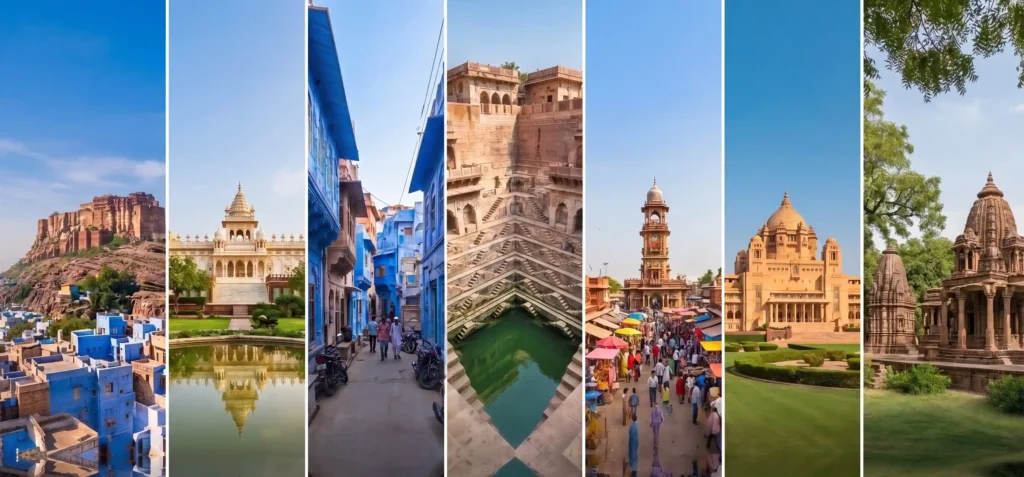
Mehrangarh Fort — One of the Great Forts of India
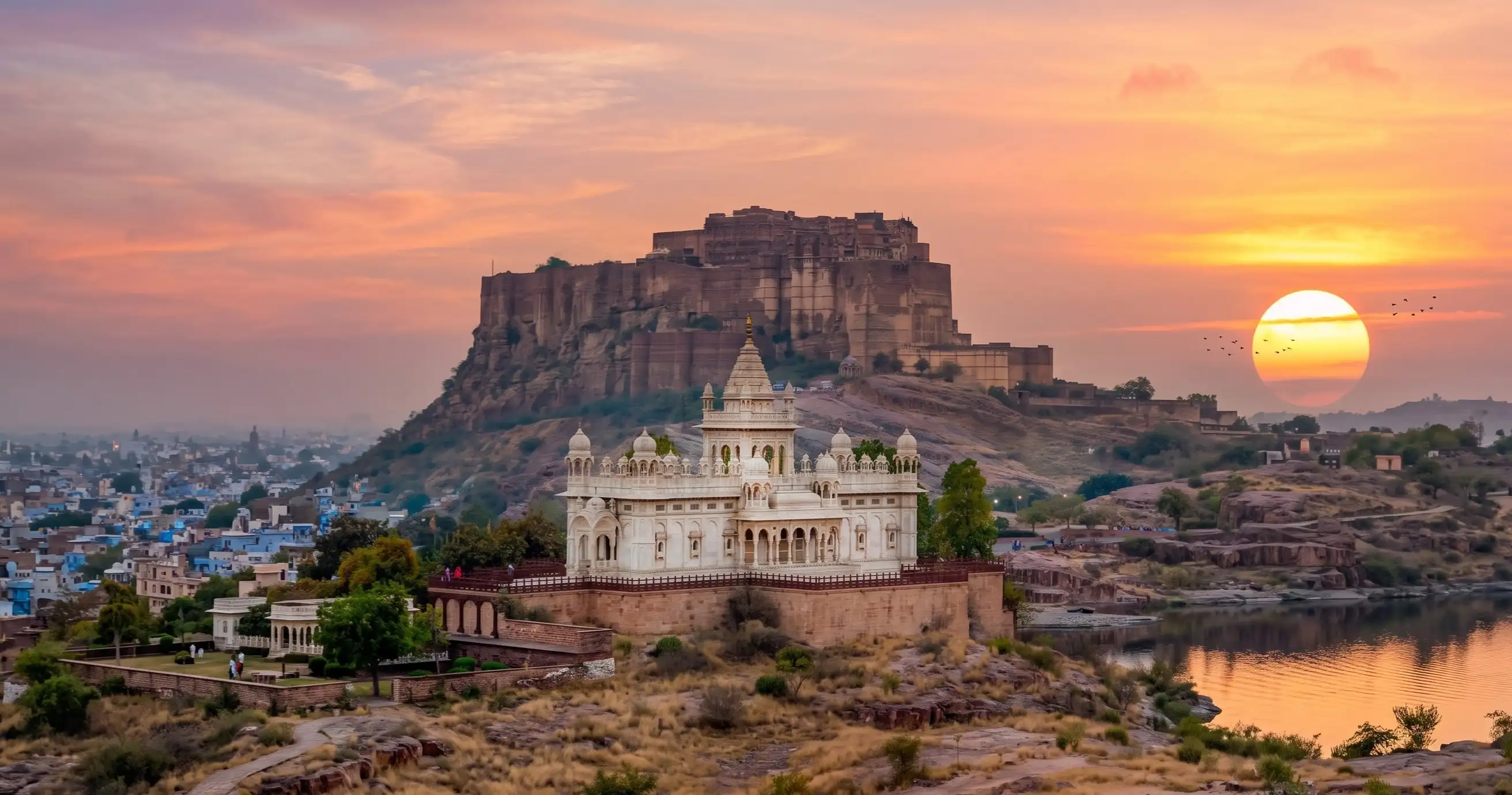
Mehrangarh rises 122 metres straight out of the rock, and the walls in places run 36 metres high and 21 metres thick. Construction began under Rao Jodha in 1459 and continued for centuries. It has never fallen to an attacker, and standing at the base of the ramparts you understand why immediately.
What sets Mehrangarh apart from other Rajput forts is not scale — it is curation. The Mehrangarh Museum Trust has done a genuinely world-class job. The palanquin gallery, the arms collection, the miniature paintings and the Phool Mahal and Sheesh Mahal apartments are presented with care and clear labelling, and the audio guide is one of the best in India. Look for the handprints near Loha Pol, left by royal widows on their way to sati — a detail that stops most visitors cold.
Practical reality: enter by 9 AM. Allow 3–4 hours. There is a lift for those who need it, but the fort involves substantial walking on uneven stone either way. The Chokelao Bagh terrace café is a good, unhurried lunch stop with the best view in the city.
Jaswant Thada
Three hundred metres from the fort gate stands a white marble cenotaph built in 1899 for Maharaja Jaswant Singh II. The marble is cut so thin it glows amber when the sun is behind it. It takes thirty minutes, the gardens are quiet, and the view back toward Mehrangarh is the one most photographers prefer to the reverse angle. Do not skip it because it looks small on the map.
The Blue City — Walk It, Don't Drive It
This is the part that separates a good Jodhpur trip from an average one. Start near Navchokiya, below the fort's western face, where the blue is densest. Walk downhill through the lanes toward the Clock Tower. You will pass open doorways, spice sellers, temple bells, children playing cricket in three-foot-wide alleys.
Why blue? The common explanations are that indigo-lime wash marked Brahmin households, that it repels insects, and that it keeps interiors cooler. All three are cited locally and all three are probably partly true. Whichever it is, the effect at 8 AM with low sunlight is remarkable.
Take a guide for this. Two hours with someone local costs little and gets you into the parts of the neighbourhood you would never find alone.
Toorji Ka Jhalra Stepwell
An 18th-century stepwell built by Maharaja Abhay Singh's queen, buried under debris for decades and excavated in the 2010s. It now sits at the centre of Jodhpur's most pleasant modern quarter, ringed by cafés and small hotels. Local teenagers dive from the upper terraces in summer. Free, five minutes' walk from the Clock Tower, and the single best example of Jodhpur restoring itself well.
Sardar Market and the Clock Tower
The commercial heart of the old city. Spices, textiles, bangles, silver, tie-dye bandhani, and the famous makhaniya lassi stalls near the tower. Bargaining is expected and good-natured. Go in the late afternoon when it comes alive, and keep valuables secure — it gets genuinely crowded.
Umaid Bhawan Palace
Built between 1928 and 1943 as a famine-relief public works project employing thousands, and one of the largest private residences in the world. It is split three ways today: the royal family's residence, a Taj hotel, and a museum. Only the museum is open to general visitors, and it is modest — a car collection, some clocks, family photographs.
Honest verdict: worth an hour if you have the time, skippable if you do not. The building is spectacular from outside and underwhelming from the inside unless you are staying there.
Mandore Gardens
Nine kilometres north, the pre-1459 capital of Marwar. Red sandstone cenotaphs built like temples, a hall of heroes, langur monkeys everywhere, and almost no foreign tourists. It is a pleasant local park with real history in it. Half a morning, low cost, high reward for anyone tired of ticketed monuments.
Best Day Trips From Jodhpur
Bishnoi Village Safari (Half Day)
Twenty to thirty kilometres out, the Bishnoi community has practised environmental conservation as religious doctrine since the 15th century — protecting khejri trees and blackbuck long before conservation was a word anyone used. A village jeep safari typically includes a potter's workshop, a weaver's home, an opium-ceremony demonstration and blackbuck or chinkara sightings at the waterholes.
Be selective about operators. The good ones have genuine long-term relationships with the villages. The poor ones run a staged loop that feels extractive to everyone involved. Ask how long they have worked with the specific families before you book.
Osian (Full or Half Day)
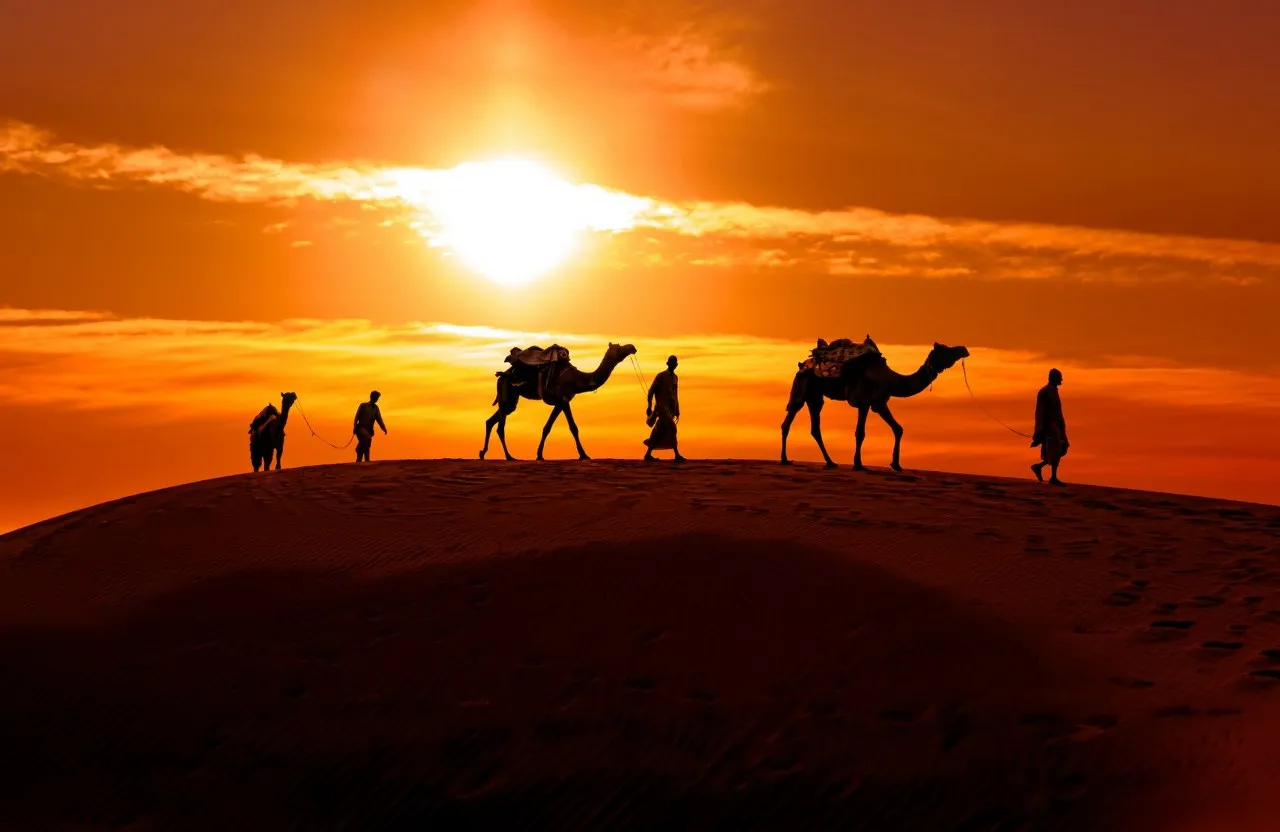
Sixty-five kilometres north, an ancient Jain and Hindu temple town on the old caravan route, with sandstone temples from the 8th to 12th centuries — including the Sachiya Mata temple, still actively worshipped. It also works as a lighter alternative to Jaisalmer for a camel ride and a dune camp if you are short on days.
Osian, Khichan and the Demoiselle Cranes (Seasonal)
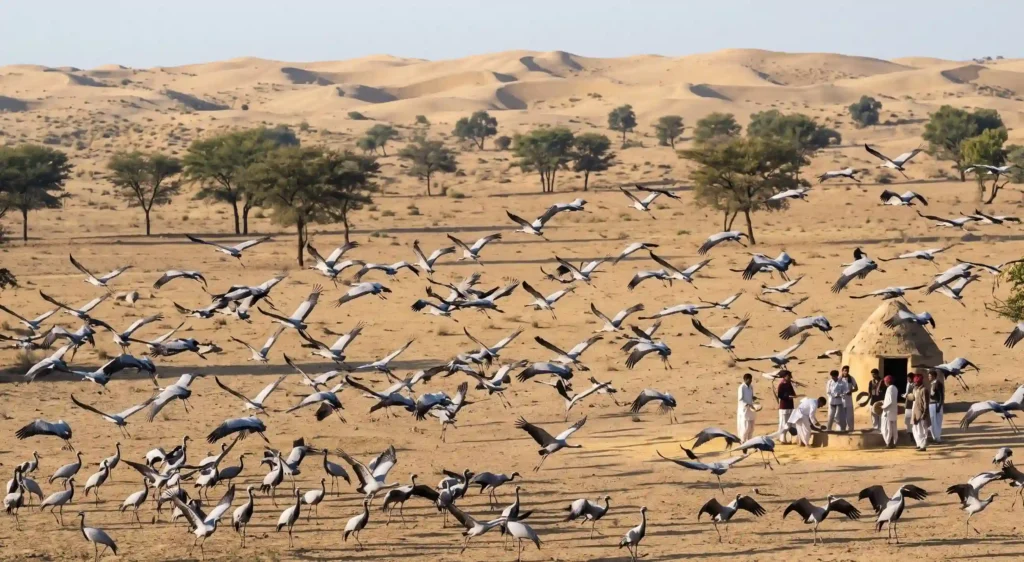
Between roughly November and February, the village of Khichan hosts thousands of demoiselle cranes that migrate from Central Asia and are fed daily by the villagers. It is one of the great wildlife spectacles in India and almost entirely absent from mainstream itineraries. Worth building a morning around if your dates line up.
Perfect 2-Day Jodhpur Itinerary
Day 1 — Fort and Old City
• 8:30 AM: Mehrangarh Fort. Audio guide, museum galleries, ramparts (3–4 hrs).
• 12:30 PM: Lunch at Chokelao Bagh inside the fort complex.
• 2:00 PM: Jaswant Thada (30–45 min).
• 4:00 PM: Guided walk down through the Blue City to the Clock Tower.
• 6:00 PM: Sardar Market, then a makhaniya lassi.
• 8:00 PM: Dinner on a rooftop facing the illuminated fort. Book ahead in season.
Day 2 — Around Jodhpur
• Early morning: Bishnoi village jeep safari (4–5 hrs) or drive out to Osian.
• Afternoon: Toorji Ka Jhalra and the cafés around it; Umaid Bhawan museum if you want it.
• Late afternoon: Mandore Gardens, or shopping in the Nai Sarak textile lanes.
• Evening: Sunset from the fort's outer ramparts or the Rao Jodha Desert Rock Park trail.
if you only have 1 day: Mehrangarh in the morning, Jaswant Thada, Blue City walk, market in the evening. Drop everything else.
Best Time to Visit Jodhpur
Jodhpur sits on the eastern edge of the Thar and its weather is more extreme than Udaipur's.
October to March is the sightseeing season. Days run 24°C to 30°C, evenings are cool, and the light on the sandstone is at its best. December and January nights can drop to 8–10°C, so bring a proper jacket — travellers routinely underestimate desert winters.
February brings the best combination of weather and lower crowds than the December peak.
April to June is genuinely hard: 40°C to 45°C is normal, and the fort's stone surfaces radiate heat well into the evening. If you must come, do everything before 10 AM and after 5 PM, and drink far more water than feels necessary.
July to September brings some rain and heavy humidity. The desert briefly greens, prices drop sharply, and Marwar Festival falls in this shoulder period. It is a reasonable trade if budget matters more than comfort.
Festival timing: the Marwar Festival, held around Sharad Purnima, fills the city with folk music and Mehrangarh with performances. The Rajasthan International Folk Festival (RIFF) at the fort is one of India's best music events. Dates shift each year with the lunar calendar — confirm on the Rajasthan Tourism official website before you build a trip around them.
Festival timing: the Marwar Festival, held around Sharad Purnima, fills the city with folk music and Mehrangarh with performances. The Rajasthan Tourism official website (RIFF) at the fort is one of India's best music events. Dates shift each year with the lunar calendar — confirm on the Rajasthan Tourism official website before you build a trip around them.
Our best time to visit Rajasthan guide has the full month-by-month breakdown for every city in the state.
How to Reach Jodhpur
By air: Jodhpur Airport (JDH) is around 5 km from the city — one of the most conveniently placed airports in India — with flights from Delhi, Mumbai and Jaipur. It is a shared civil-military airfield, so photography around the terminal is restricted.
By train: Jodhpur Junction is a major hub with direct services from Delhi, Jaipur, Ahmedabad, Mumbai and Jaisalmer. The overnight Jaisalmer train is a genuinely good travel experience.
By road: the most practical option for most itineraries. Jodhpur sits roughly 335 km from Jaipur, 260 km from Udaipur and 285 km from Jaisalmer, on good highways.
• Jaipur to Jodhpur cab — about 5.5 to 6.5 hours, with an optional stop at Ajmer or Pushkar
• Udaipur to Jodhpur cab — about 5 hours, with Ranakpur on the way
• Jodhpur to Jaisalmer cab — about 5 hours across open desert; the drive itself is part of the trip
If you want the whole western Rajasthan circuit handled end to end, our Udaipur Jodhpur Jaisalmer tour package links all three cities with transfers, stays and desert camping included.
What Jodhpur Actually Costs
Per person, per day, excluding intercity transport.
Budget (₹1,800–3,000/day): guesthouse near the Clock Tower or Toorji Ka Jhalra, local thalis, autos, main monuments.
Mid-range (₹4,000–7,000/day): heritage haveli or boutique hotel, rooftop dining, private cab for sightseeing, guided fort visit and village safari.
Luxury (₹15,000+/day): Umaid Bhawan or a top heritage property, private guide, curated experiences.
Jodhpur is meaningfully cheaper than Udaipur and Jaipur at every tier — usually 20 to 30 percent less for comparable quality. It is the best value city in the Rajasthan circuit.
Typical spends: Mehrangarh entry with audio guide runs a few hundred rupees for Indian visitors and more for foreign nationals, with separate camera charges. Jaswant Thada is inexpensive. A half-day Bishnoi safari with a good operator is usually ₹1,500–3,000 per person. Confirm current rates at the time of booking — they are revised each season.
Where to spend: the Mehrangarh audio guide, a local walking guide for the Blue City, and one good rooftop dinner.
Where to save: skip the Umaid Bhawan museum if time is tight, and eat lunch in the old city rather than the tourist strip.
Our complete Rajasthan travel guide has a fuller cost breakdown across the state.
What to Eat in Jodhpur
Jodhpur has the strongest food identity of any Rajasthani city, and most visitors barely scratch it.
• Mirchi bada — a whole green chilli, stuffed with spiced potato, battered and fried. The city's signature street snack. Less fiery than it sounds.
• Makhaniya lassi — thick, saffron-scented, served in a clay cup near the Clock Tower. A meal in itself.
• Pyaaz kachori — flaky, onion-stuffed, best eaten within minutes of frying.
• Dal baati churma — the Rajasthani classic. Have it once at a proper restaurant rather than a hotel buffet.
• Laal maas — fiery Marwari mutton curry built on Mathania red chillies. If you eat meat and can handle heat, this is the dish of the region.
• Kabuli and gatte ki sabzi — the vegetarian dishes locals actually eat at home.
A note on street food: eat where there is turnover. Busy stalls at 6 PM are safer than quiet ones at 3 PM, everywhere in India.
For more on the food, crafts and traditions behind all of this, read our Rajasthan culture and tradition guide
Local Tips Most Jodhpur Travel Guides Leave Out
Go up early, come down late. Mehrangarh at 9 AM is calm; by noon it is full. The outer ramparts near sunset are quieter than the museum galleries and have the better view.
The old city is a walking city. Cars cannot reach most Blue City guesthouses. Expect to walk the final stretch. Soft luggage beats hard cases here even more than in Udaipur.
Ask before photographing people. The Blue City lanes are residential. Most residents are gracious about it; asking first is what keeps them that way.
Buy textiles here, not in Jaipur. Bandhani tie-dye, block prints and Marwari embroidery are cheaper and often better in Jodhpur's Nai Sarak and Kapra Bazaar than in Jaipur's tourist-facing shops.
Watch out for commission-driven "guides" who approach you outside the fort gates offering to take you to shops. The official fort guides and pre-booked local guides are a different category entirely.
Winter nights are properly cold. December and January evenings on a rooftop restaurant need a jacket, not a shawl.
Frequently asked questions
How many days in Jodhpur do you need?
Why is Jodhpur called the Blue City?
Is Mehrangarh Fort worth visiting?
Jodhpur or Udaipur — which is better?
What is the best time to visit Jodhpur?
Is Jodhpur safe for tourists?
How far is Jodhpur from Jaisalmer?
Can I stay inside Mehrangarh Fort?
Plan Your Jodhpur Trip With Root Indians
Jodhpur rewards travellers who slow down and walk, which is the one thing this Jodhpur travel guide keeps returning to. Our job is to remove the friction around that — the transfers, the timings, the fort tickets, the right guide for the Blue City — so your two days are spent looking at the city rather than solving it.
Root Indians is a Rajasthan-based operator with our own AC fleet, background-verified drivers who know the Marwar routes, and fixed transparent pricing with no hidden charges. We are based in the state we sell, which is not true of most companies you will find online.
Whether you want a two-day Jodhpur stopover, the full western Rajasthan circuit, or a custom itinerary built around the crane migration or RIFF, we will plan it around your dates.
Ready to plan your Jodhpur trip? Contact Us today. We will build Your Best itinerary that fits your dates, budget, and travel style. Call 78777-38437 or visit our website to explore our tour packages.